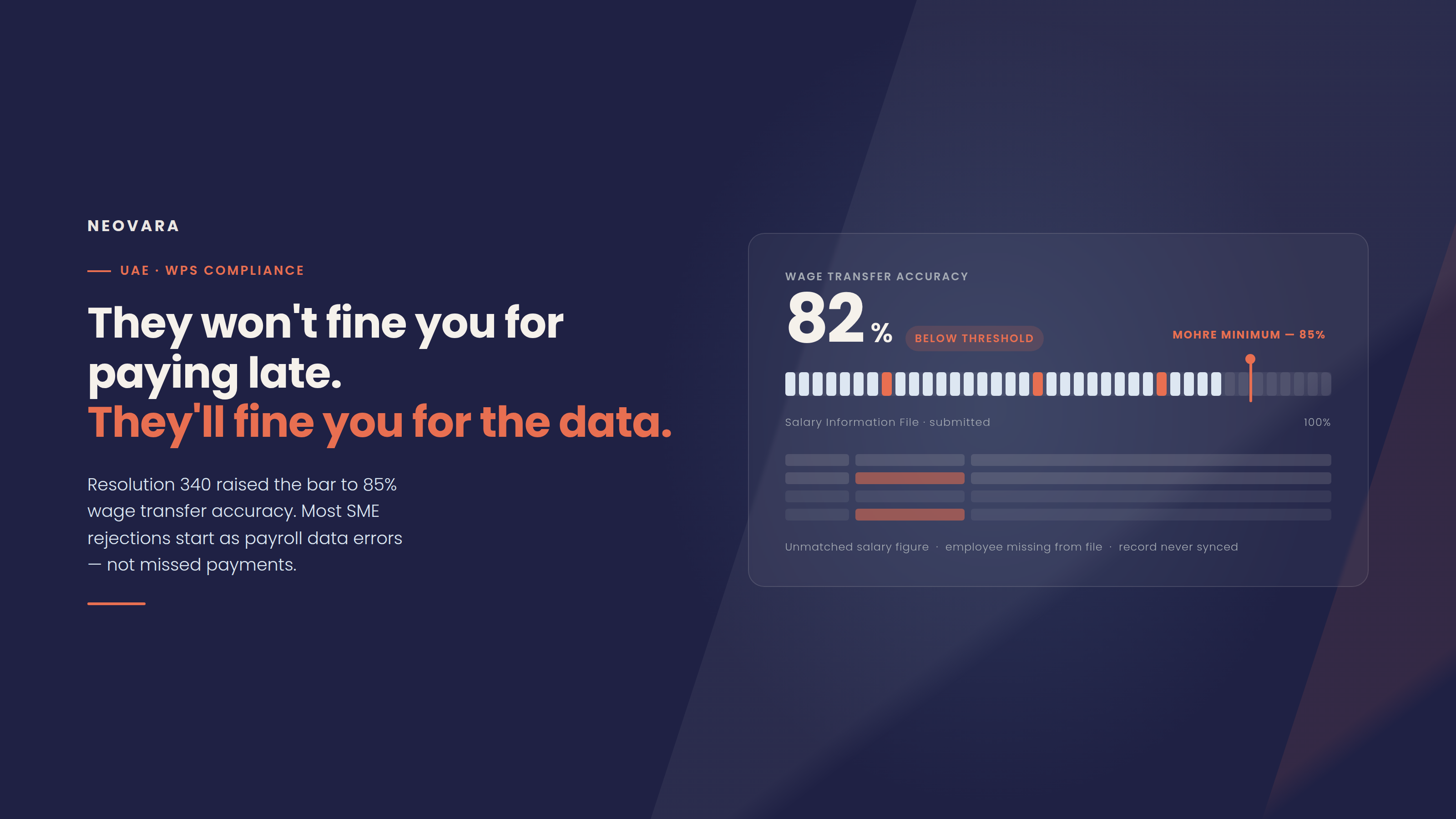
Most SMEs think WPS compliance means paying wages on time. Since Resolution No. 340 of 2026 took effect on 1 June, that’s no longer the whole picture: MOHRE now requires at least 85% of every individual employee’s wage to land correctly, on time, matched exactly to the salary figure it holds on to file. A payroll spreadsheet that’s a few dirhams out of sync, or an employee left off the salary file by mistake, now reads as a violation — not a rounding error.
Why the June 2026 Rules Changed the Risk Calculus
Resolution 340 raised the compliance threshold from 80% to 85% and moved every employer onto one deadline: wages for the previous month must clear by the 1st. It also removed the old 30-day grace period for new hires, so a payroll system has to be accurate from an employee’s first day, not their second month. None of this is optional or sector-specific — it applies to every MOHRE-licensed private company, with narrow exemptions for staff paid abroad or on short-term permits. What makes it unforgiving is the escalation clock. Monitoring starts on day one. By day five, new work permits are suspended. By day sixteen, employers with 25 or more staff have permits frozen outright — before a single fine has even been issued.
The Data Failures That Actually Trigger It
WPS rejections rarely start as payment problems — they start as data problems inherited from disconnected HR, payroll and banking systems. The Salary Information File (SIF) MOHRE checks against is only as accurate as the records feeding it, and four failure patterns account for most SME violations: an employee missing from the SIF entirely (read as non-payment, even if paid another way), a transferred amount that doesn’t match the registered salary, an outdated record after a raise or role change that was never synced, and a payment made outside WPS “just this once.” That last one is the costly surprise: a single off-channel transfer doesn’t flag one employee — it can freeze every work permit tied to that employer’s file.
What WPS-Ready Payroll Data Actually Looks Like
Readiness isn’t a payroll software feature — it’s a data state. It means HR, payroll and finance are working from one employee master record, not three, so a salary changes updates everywhere the moment it happens. It means labor card numbers, IBANs and salary structures are reconciled against MOHRE’s records before a file is ever submitted, not after it bounces. For most SMEs, that reconciliation is a one-time back-office cleanup, not a permanent fix. Businesses with fragmented HR/payroll/banking data typically need two to six weeks to bring master records into a submittable state, depending on headcount — versus the compounding cost of permit suspensions and reclassification once MOHRE has already flagged the file.
FAQ
What happens if my WPS salary file gets rejected in the UAE?
Enforcement escalates fast: monitoring starts day one, warnings follow on day two, new work permits are suspended by day five, and by day sixteen employers with 25+ staff face a full permit freeze — all before fines, travel bans, or prosecutorial referrals kick in from day eleven onward.
Does the new 85% WPS threshold apply to all UAE private companies?
Yes. Resolution No. 340 of 2026, effective 1 June 2026, applies to every MOHRE-licensed private sector company, replacing the old 80% threshold. Exemptions are narrow — foreign staff paid abroad, employees under liberty restrictions, and short-term permit holders — and new hires no longer get a 30-day grace period.
Neovara helps ambitious SMEs turn fragmented back-office data — payroll, invoicing, POS — into systems that pass MOHRE and FTA checks the first time, not the third. If your HR, payroll and banking data haven’t been reconciled since before Resolution 340, that’s worth finding out before MOHRE tells you.
Book a free 20-minute WPS data readiness call with Neovara →