
Is your restaurant's data ready for AI? Five checks you can run this week
Every AI pitch starts with the clever part: the agent, the dashboard, the forecast. Almost nobody asks to see your data first. That's the wrong way round. An AI tool built on a POS export that doesn't match Xero will give you wrong answers, faster and with more confidence.
So before you sit through another demo, spend a few hours with your own numbers. Here are five checks any restaurant, café or hotel F&B team can run this week, with nothing more than system exports and a spreadsheet.
The short answer
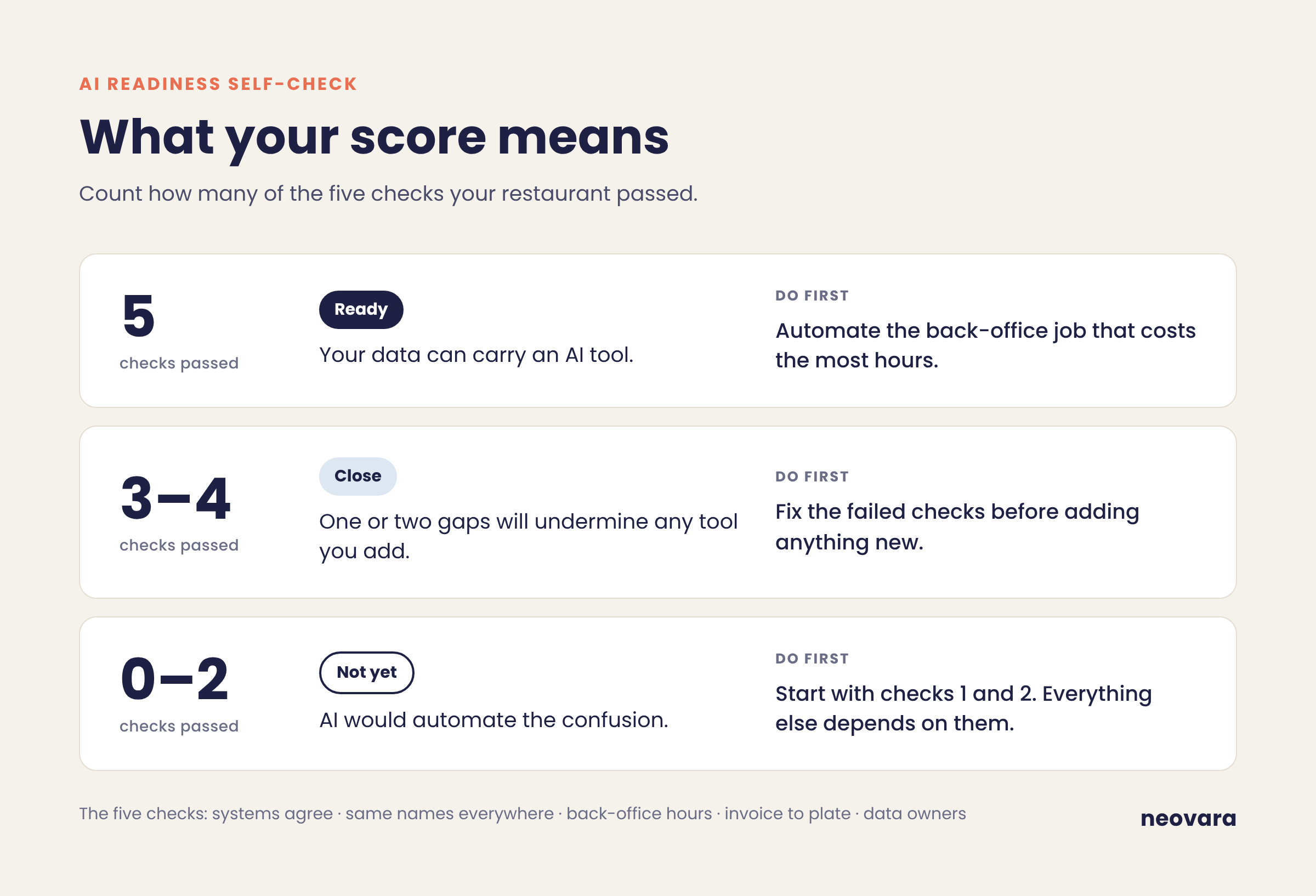
our restaurant's data is ready for AI when your systems agree with each other, things are named the same way everywhere, you know where your back-office hours go, you can trace a dish from invoice to plate, and someone owns each data source. Fail two or more of the five checks below and the first job is fixing the data, not buying a tool.
1. Do your systems agree on yesterday's sales?
Pick one normal trading day. Pull net sales for one outlet from three places: the POS, each delivery app's report (Talabat, Deliveroo, Careem) and Xero or whatever you close the books in.
The numbers won't match to the dirham, and that's fine. Commissions, refunds and timing all get in the way. The test is whether someone on your team can explain every gap within 15 minutes. If the answer is "we sort it out at month-end", you've found your first problem.
2. Is everything called the same thing everywhere?
Open your supplier list and search for one ingredient. Count how many ways it's been entered. Do the same for outlet names across the POS, the inventory system and the chart of accounts.
AI matches things by name and code. If one outlet is "JBR", "JBR Walk" and "Outlet 3" depending on the system, every report that joins them up needs a person to translate first.
3. Where do your back-office hours actually go?
For one normal week, ask your finance and admin team to note time spent on four jobs: keying invoices, reconciling delivery payouts, building reports and chasing missing information.
Most teams have never added this up. Once you have, you know which job is worth automating first, and roughly what it costs you every month to leave it as it is.
4. Can you trace one dish from invoice to plate?
Choose your best-selling dish. Can you go from the supplier invoice price, to the recipe cost in your inventory system, to the menu price and sales in the POS, without retyping anything?
If you can, you can compare what your food cost should have been with what it actually was, and find out where the difference went. If you can't, food cost stays a number you see once a month, too late to act on.
5. Who owns each data source?
List every system that holds business data: POS, delivery apps, inventory, accounting, reservations, HR and the spreadsheets that fill the gaps. Next to each, write who owns it and who can export from it.
Watch for the single spreadsheet only one person understands, and for logins that sit with an old employee or an agency. This also matters for compliance. UAE businesses with revenue under AED 50M must appoint an e-invoicing Accredited Service Provider by 31 March 2027 and go live on 1 July 2027 (KPMG). Clean, owned invoice data makes that a much smaller project.What your score means
Where AI fits once the data is right
The checks above are also a map of where AI pays off. Payout reconciliation, invoice matching, leakage alerts on voids and refunds, plain-English answers about your numbers: each one gets easier once the data underneath is consistent. Fix the foundations and the useful AI work becomes the easy part.
If you'd rather not run it yourself
These five checks are a short version of what we look at in our AI & Data Health Check. It's a two-week review in which we go through your systems, partly using AI to test the data itself, and hand back four things: a data health score, a map of where your back-office cost goes, the five AI or automation opportunities most worth doing, and a 90-day plan.
Run the checks yourself first. If you get stuck on one, or the results raise more questions than answers, we're happy to talk them through.
Talk through your results with us
FAQ
How do I know if my restaurant's data is ready for AI?
Check whether your POS, delivery apps and accounts agree on sales, whether outlets, items and suppliers are named consistently, and whether you can trace a dish's cost from invoice to sale. If two or more of those fail, fix the data before buying a tool.
What does it take to fix restaurant data?
It depends on how many systems you run and how far they've drifted apart. Matching names and codes across systems and setting up a daily reconciliation are the usual starting points.
Do I need new systems to get my data ready?
Not necessarily. Check how your existing systems are set up and connected before you replace any of them.