
How does AI demand forecasting work for restaurants in Dubai?
AI demand forecasting for restaurants uses machine learning models trained on a restaurant's own records, such as past sales, holiday dates, menu attributes and stock levels, to predict how much will sell. In a 2026 study of a university restaurant, the best model predicted meal demand more closely than the restaurant's existing forecast.
Key facts
Dubai welcomed 19.59 million international overnight visitors in 2025, with average hotel occupancy of 80.7% (Dubai Department of Economy and Tourism, February 2026).
Dubai hotel occupancy fell to 36% in March 2026 and reached 66% in August 2026, which was 89% of the August 2025 level (Dubai Department of Economy and Tourism, September 2026).
Dh6 billion worth of food is wasted in the UAE every year (Mariam Al Mheiri, UAE Minister of Climate Change and Environment, 2022).
What data does an AI demand forecast for a restaurant use?
An AI demand forecast for a restaurant uses the restaurant's historical sales or consumption, plus variables that explain changes in demand, such as holidays, menu attributes and stock on hand. Two published 2026 examples show which inputs were used.
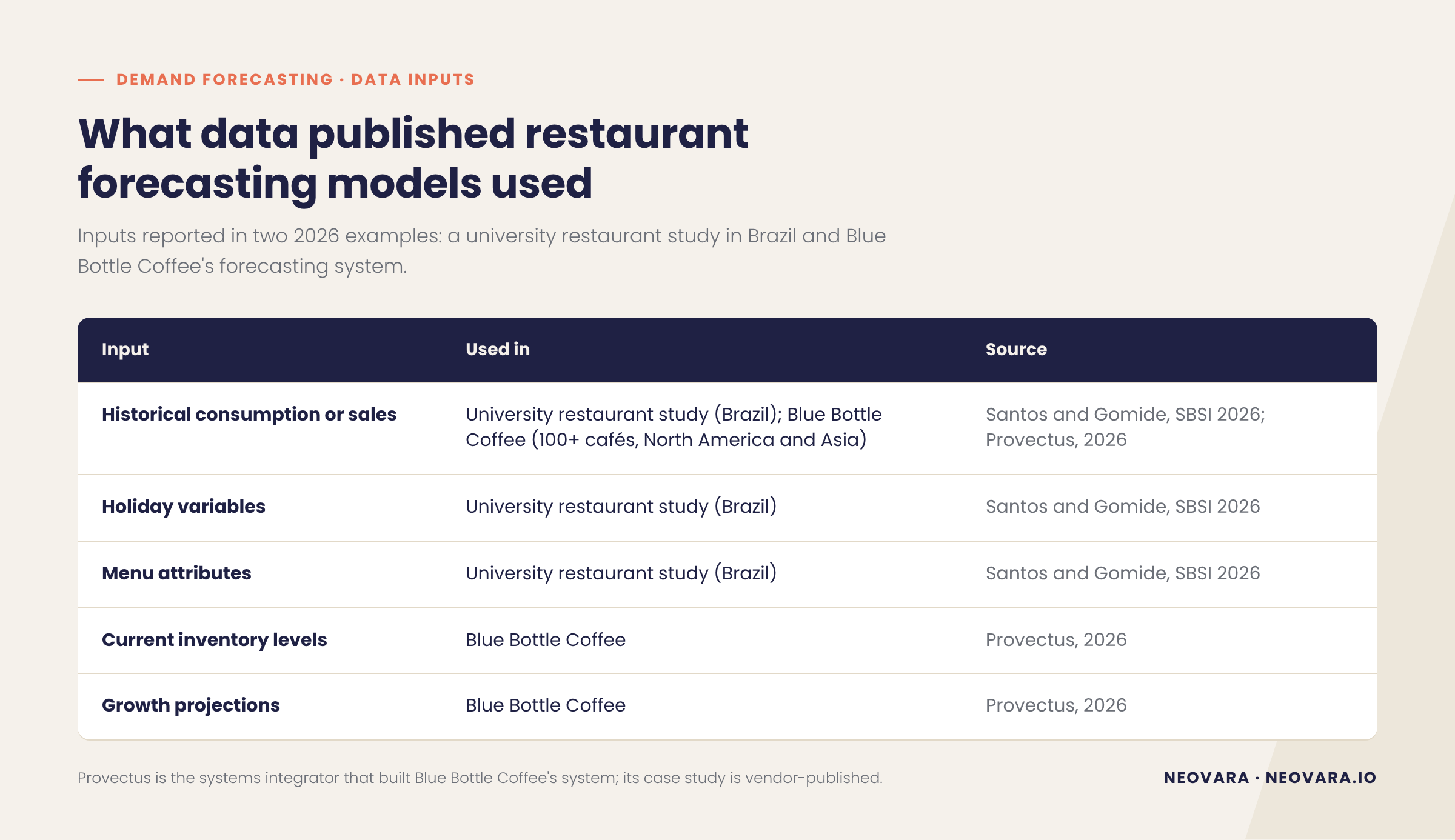
In the university restaurant study, researchers at the Federal University of Rio de Janeiro compared three model types: decision tree, XGBoost and LSTM. XGBoost performed best, with an R² of 0.92 against 0.83 for the restaurant's original forecast. R² measures how much of the variation in demand a forecast explains, where 1.0 is a perfect fit.
Blue Bottle Coffee's forecasting system, built by the systems integrator Provectus, improved pastry ordering accuracy by 8% in its first month. That figure comes from Provectus's own case study, published in May 2026.
How different is Dubai's 2026 trading from 2025?
Dubai's 2026 trading has been well below 2025. Hotel occupancy fell to 36% in March 2026 after disruption to international travel across the region, and was 66% in August 2026, 89% of the August 2025 level, according to the Dubai Department of Economy and Tourism (DET).
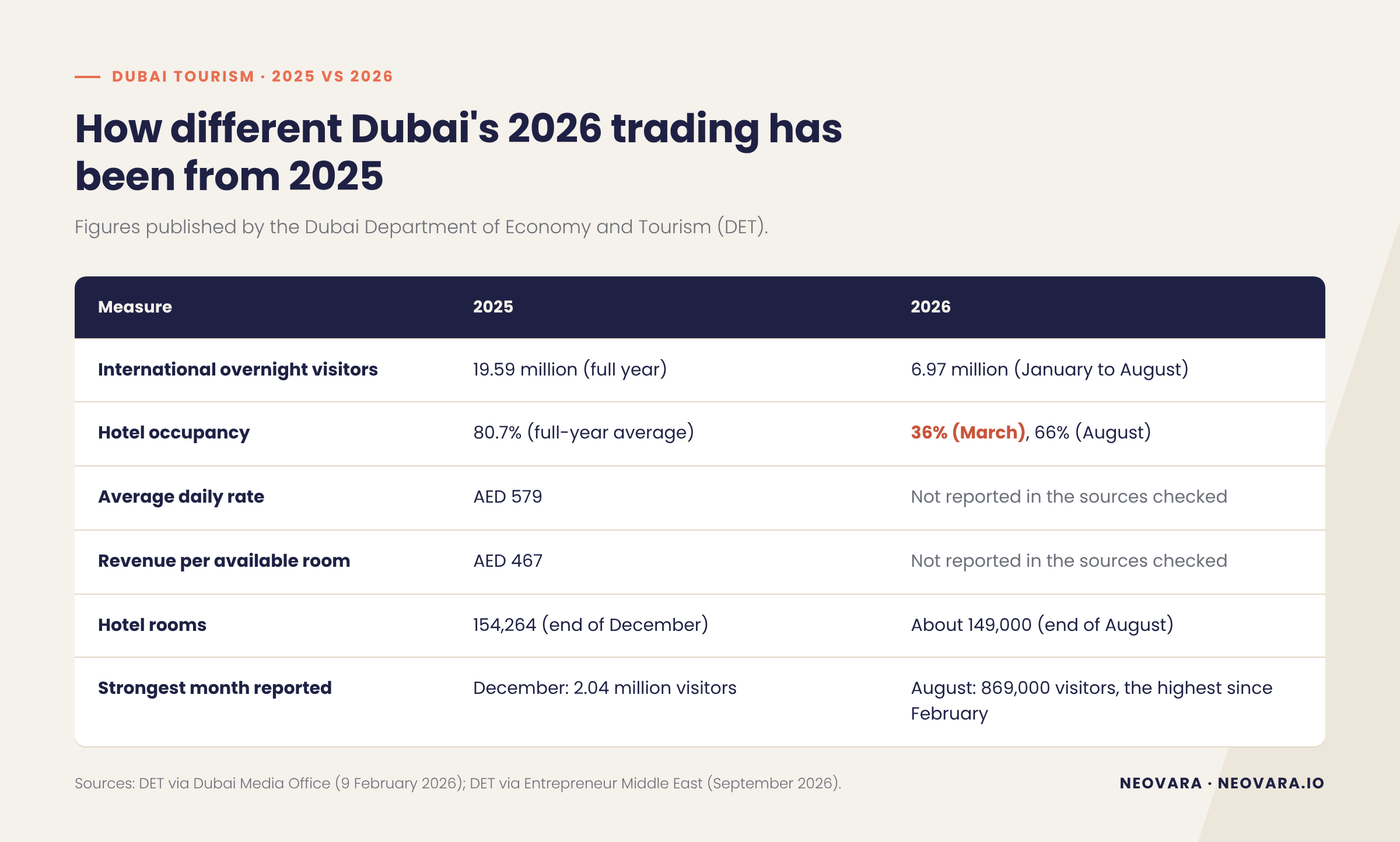
December 2025 was the first month Dubai passed 2 million international visitors, according to DET. Entrepreneur Middle East, reporting the September DET figures, notes that the Dubai government introduced an AED 2.5 billion support package for the tourism, hospitality and entertainment sectors after the disruption earlier in 2026.
Rotana's chief executive says demand is hard to predict. Philip Barnes, CEO of Rotana, told Gulf News in September 2026 that guests are booking at short notice and "the predictability is really challenging."
For a restaurant in Dubai building a forecast, these figures mean 2025 and 2026 sales history were recorded under very different trading conditions.
What have UAE hospitality businesses achieved by measuring food waste?
Two published UAE hospitality trials cut food waste by 8% and 62%. Both results came from waste measurement and behaviour change, not from demand forecasting.
ne'ma's 2023 trial covered 190 F&B outlets from hospitality groups, caterers and food suppliers, which cut food waste per diner by 8%, equal to 15.2 tonnes. The trial ran in two 5-week phases: a baseline phase under normal operations, then a phase with behavioural changes, with Winnow technology used for data tracking.
Hilton's 2023 Green Breakfast pilot cut food waste at 13 Hilton hotels in the UAE by 62% between August and November 2023, counting pre- and post-consumer waste. Pre-consumer waste fell by more than 76% and post-consumer waste by 55%. Hilton used Winnow's AI-powered production and plate waste systems, weekly coaching and regular reporting.
The national context: Dh6 billion worth of food is wasted in the UAE every year, according to the UAE Minister of Climate Change and Environment in 2022. ne'ma, the national food loss and waste initiative, has a target to reduce food loss and waste by 50% by 2030.
What is different about demand forecasting for restaurants in the UAE?
Restaurants in the UAE forecast around a Ramadan that moves each year and a visitor base drawn from several regions. Both are documented in published data.
Ramadan moves earlier each year. The holy month shifts around 10 to 11 days earlier each year because the Islamic lunar calendar is about 11 days shorter than the Gregorian year (Gulf News, August 2026). Ramadan 2027 is expected to begin on 8 February 2027 based on astronomical calculations, subject to the official moon sighting (Gulf News, August 2026; The National, September 2026). In the university restaurant study, holiday variables were one of the model's inputs.
The visitor base is broad. From January to August 2026, Dubai's international visitors came mainly from Western Europe (20%), South Asia (17%), the GCC (16%) and the CIS and Eastern Europe (14%), according to DET.
Where should a restaurant group start with demand forecasting?
A restaurant group can start with the steps used in the published trials above: record a baseline, measure waste, then test a forecast against the current method.
Record a baseline under normal operations. The ne'ma trial ran a 5-week baseline phase before making any changes, so results could be compared.
Measure waste by item. Both UAE trials used Winnow tracking. Hilton added weekly coaching and regular reporting.
Include holiday variables. The university restaurant model used them as inputs. In the UAE, that includes Ramadan's moving dates.
Compare the model with the current forecast. The university restaurant study judged its models against the restaurant's original forecast, using the same historical data.
Neovara, a Dubai-based AI and data consultancy for F&B and hospitality businesses, builds one source of truth from a business's data to cut back-office cost.
FAQs
Can AI reduce food waste and food cost %?
AI-based waste tracking has cut food waste in UAE hospitality. In 2023, 13 Hilton hotels in the UAE cut pre- and post-consumer food waste by 62% over 4 months using Winnow's AI-powered tracking, weekly coaching and regular reporting. In a separate 2023 ne'ma trial, 190 UAE F&B outlets cut food waste per diner by 8%. Neither source reported a food cost % figure.
Can AI handle inventory, stock counts and supplier ordering for a restaurant?
AI already counts restaurant inventory at scale. In 2025, Starbucks deployed an AI tool built with NomadGo that counts ingredients using tablet cameras, computer vision and augmented reality. Stores using it count inventory 8 times more frequently, and Starbucks said the tool may later automate some restocking orders (Restaurant Dive, September 2025). Blue Bottle Coffee's forecasting system uses current inventory levels as an input.
What data does a restaurant need in place before using AI demand forecasting?
A restaurant needs historical sales or consumption records as a minimum. In a 2026 university restaurant study, the forecasting model also used holiday variables and menu attributes. Blue Bottle Coffee's system, described in a 2026 Provectus case study, used historical sales, current inventory levels and growth projections. Both published examples relied on the business's own historical records to train the model.
How much does AI demand forecasting cost for a restaurant, and what return should I expect?
Cost depends on whether the forecast comes as a module in an existing POS or inventory system, or as a custom model built on a group's own data. [CHECK: get current UAE pricing for 2 to 3 POS-integrated forecasting modules before quoting any range.] Measure the return in wastage, food cost % and labour cost per cover, against a baseline recorded before the forecast goes live.
Is AI worth it for a small restaurant or a single café?
Published forecasting results so far come mostly from larger operators, such as Blue Bottle Coffee's 100+ cafés. Among smaller operators, Toast's 2026 survey of 676 US restaurant operators with 16 or fewer locations found 87% comfortable using AI and 81% saying AI tools offer great value for the money. That survey covers AI broadly, not forecasting, and is from the US, not the UAE.
The practical next step
Start with a baseline: record covers and food waste by item under normal operations for 5 weeks, the same baseline period ne'ma used in its 2023 UAE trial. That record is what any forecast, or any later improvement, will be measured against.